
Listen instead
When someone asks ChatGPT “What’s a good chiropractor near me?” or “Find me a Baptist church in Virginia” — does your website come up? For most small businesses and churches, the answer is no. Not because AI doesn’t want to recommend you. Because it can’t find you.
A previous post on this blog raised the question of whether a site gives AI systems enough useful public context. This one explains practical content structure. You may not need a new website; you may need clearer public information.
More people now ask ChatGPT, Perplexity, and Google’s AI features for answers instead of scrolling a list of links. How big that shift is depends on who’s measuring — the AEO explainer keeps the published numbers and their limits in one place. If your site isn’t built for this — if it can’t be read, parsed, and cited by these systems — you’re missing a channel more customers are starting to use.
AEO (Answer Engine Optimization) is structuring content so AI can pull direct answers. GEO (Generative Engine Optimization) is optimizing for AI-generated search results. Both are about making your site visible to AI — not just Google.
How AI Search Is Different
Google crawls and indexes pages, then ranks them. AI reads, summarizes, and cites — or doesn’t cite. The distinction matters more than it sounds.
When ChatGPT answers a question, it draws on two things: what it learned during training (with a cutoff date, like a textbook published last year) and, in some modes, real-time web search. When Perplexity answers, it searches the web fresh for every single query and cites what it finds. Google AI Overviews pull directly from Google’s live index. Each platform has its own citation logic.
What they share is this: if your content isn’t clear, structured, and direct, AI skips you. A human visitor can skim a cluttered page and find what they need. AI can’t. It looks for patterns — headings that match questions, answers near the top of sections, entities stated plainly. If those patterns aren’t there, the system moves on to a source that has them.
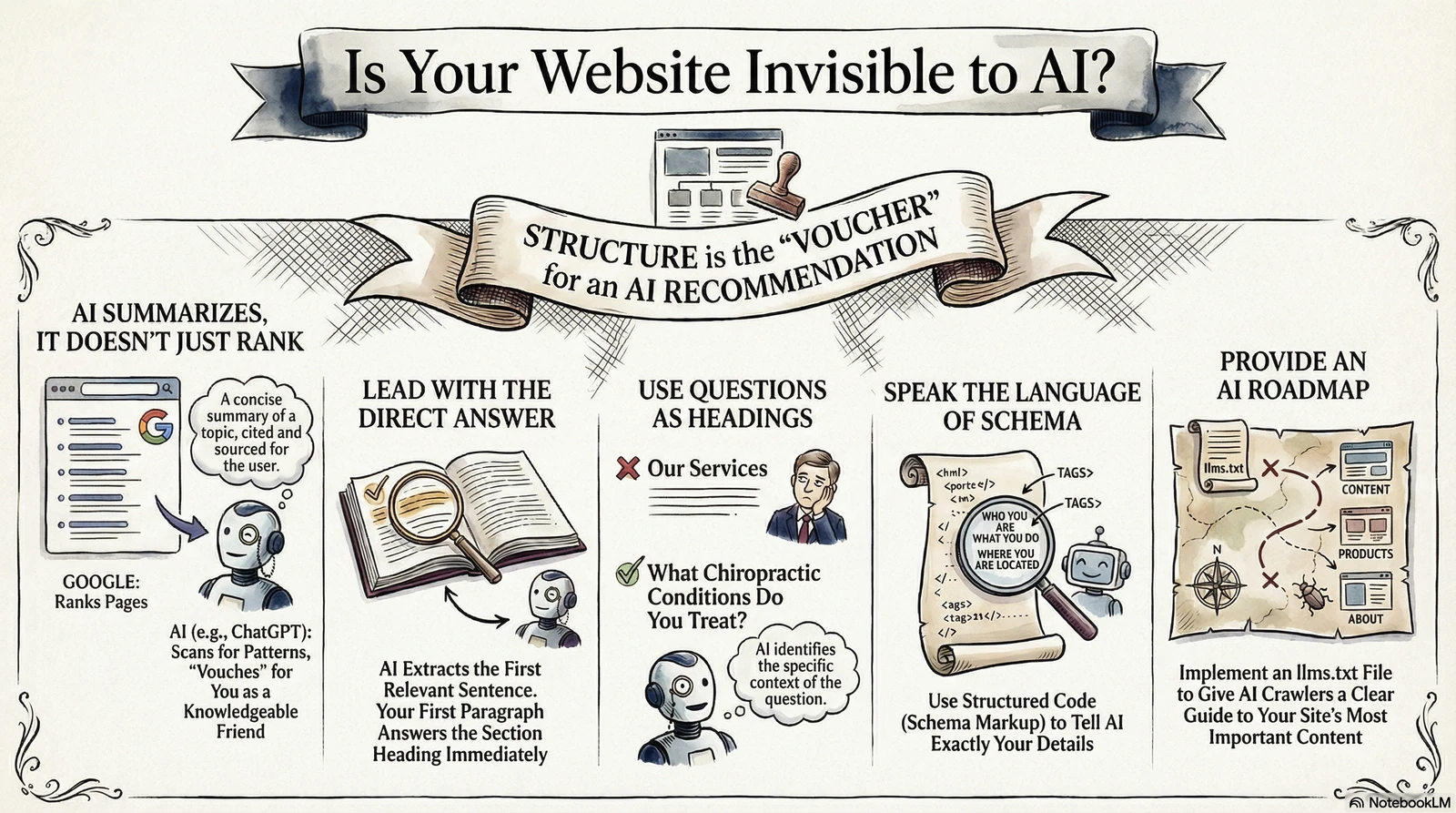
Think of it as the difference between being in a phone book (Google) and being recommended by a knowledgeable friend (AI). The phone book just needs to find you. The friend needs to understand you well enough to vouch for you. Structure is what earns the voucher.
What AI Actually Looks For
Five things consistently show up in the research on what gets sites cited by AI systems.
Clear structure. Headings that match the questions people actually ask. Not “Our Services” but “What chiropractic conditions do you treat?” Not “About Us” but “What kind of church is Lighthouse Baptist?” AI reads headings the same way a researcher scans a document — looking for the section that answers the specific question in front of it.
Direct answers in the first sentence. Every section should answer its heading question immediately. Don’t warm up to the answer. Don’t save the key detail for the third paragraph. AI extracts the first relevant sentence it finds — if the answer isn’t there, it looks elsewhere.
Schema markup. This is structured data — code added to your site that tells AI and search engines exactly what your entities are. A LocalBusiness schema says: this is a business, here’s what it does, here’s where it is. Schema helps when it matches what’s visible on the page — but it isn’t an AI opt-in. Google says there’s no special schema you need to add to appear in its AI features. Clear visible text still does most of the work. See the schema markup guide for the specifics.
Entity clarity. Who you are, what you do, and where you are — stated plainly, not buried. “We are a Baptist church in Waterbury, Connecticut, serving families in the greater New Haven area” is an entity statement. “Welcome to our community” is not. Clear public facts help people and AI systems understand the organization.
Fresh, authoritative content. Visible date signals (a published date in the page markup) appear to help on platforms like Perplexity, which favor recency when it can verify it. Thin pages — three sentences and a contact form — rarely get cited. Pages that answer a question fully and recently tend to get cited repeatedly.
AI doesn’t browse your site like a person does. It scans for structure, entities, and direct answers. If those aren’t clear, you’re invisible.
The Church Test
Try it yourself. Open ChatGPT or Perplexity and ask: “What are some good Baptist churches in [your city]?” Watch what comes up. Then ask why those churches appear and yours doesn’t — or why yours does.
Churches that surface in AI answers tend to share a few traits. They have a Google Business Profile that’s verified and complete, with service times, address, and denomination clearly stated. Their site has a real “About” page that names the denomination, describes the congregation, and uses plain language about beliefs and community. Their service information is in actual HTML text — not an image of a schedule, not a PDF download, not a slide in a graphic. Plain text that any system can read.
The church with the beautiful homepage built entirely from full-width images and decorative overlays is invisible. The pastor sees a stunning website. ChatGPT sees nothing it can read. For church websites, structure is not a design constraint — it’s the whole game.
The Business Test
Run the same test for a healthcare practice or local business. Ask Perplexity: “Who are the best chiropractors in [your city]?” The practices that get cited have a few things in common: clear service descriptions (not just service names), FAQ content that addresses real patient questions, and accurate business details — what conditions they treat and where they’re located — stated plainly on the page.
“We treat pain” is not a citable statement. “We provide chiropractic care for lower back pain, neck stiffness, and sports injuries in Richmond, Virginia” is. One of those sentences an AI can use to answer a specific question. The other it can’t. For healthcare and wellness practices, specificity is the difference between being cited and being skipped.
AEO vs. GEO — Same Shift, Two Names
You’ll see both terms used in the industry, sometimes interchangeably. Here’s the practical distinction. AEO — Answer Engine Optimization — focuses on being the source AI cites when someone asks a specific question. “What does a chiropractor do?” “What do Baptists believe?” Your content either answers those questions cleanly enough to be pulled, or it doesn’t. GEO — Generative Engine Optimization — is the broader discipline of appearing favorably in AI-generated results overall, not just for specific answer pulls.
Both require the same foundation: structured content, schema markup, and entity clarity. Optimizing for one gets you most of the way to the other. Think of AEO as the precision layer and GEO as the full strategy. You need both — and neither requires rebuilding your site from scratch. For the full breakdown — including where the term GEO actually comes from and what the research says works — see What Is Answer Engine Optimization? AEO vs. GEO vs. SEO, Explained.
What to Actually Do
Five practical steps, in order of impact.
1. Structure content as Q&A. Go through your main service pages and ask: what question does each section answer? Rewrite the heading to match that question. Put the direct answer in the first sentence of the section. This alone is the highest-leverage change most sites can make.
2. Add accurate schema markup. LocalBusiness (or Church, MedicalBusiness, etc.) and BreadcrumbList are good basics, as long as they match what’s visible on the page. Schema describes your facts; it doesn’t opt you into AI answers. The schema markup guide walks through exactly how to implement each type. Correction, September 2026: this step used to list FAQPage as a minimum and said schema stops AI from guessing. Google’s FAQ rich results stopped appearing in May 2026, and Google says no special schema is needed for its AI features.
3. State your entity clearly. Every page should answer three questions in plain text: who you are, what you do, and where you are. Not buried in the footer. Not hidden in an image. In readable HTML, near the top of the page, in plain language.
4. Consider an llms.txt file. — Correction, August 2026. This section originally recommended adding an llms.txt file — a plain-text roadmap at your site root telling AI crawlers what your site contains. The evidence since says it doesn’t do that job. In May 2026, Ahrefs analyzed 137,210 domains and found 97% of valid llms.txt files got zero requests in a month; no major AI company reads it in production, and Google’s John Mueller has said it’s “not done for search.” It remains genuinely useful for coding agents parsing developer docs — a different job. If you already have one, it’s harmless to keep. We haven’t removed ours. But we no longer count it as AI-visibility work. Full explanation in SEO Advice That Stopped Working.
5. Run a visibility scan. The Artifex Visibility Report is a free automated on-page website diagnostic. It checks selected public-page signals across technical health, on-page search signals, structured information, and content clarity. It does not test what AI systems see or predict citations. About 30 seconds.
SEO gets you into Google’s index. AEO gets you into AI’s answers. You need both — and the foundation for both is good structure and clear content.
// FURTHER READING
- The llms.txt Specification — The original proposal for the llms.txt format. Useful background on what the file was meant to do — read it alongside the correction in step 4 above.
- What Is Answer Engine Optimization? — Conductor — A thorough enterprise guide to AEO covering the core concepts, techniques, and how it connects to traditional SEO. Good reading before diving into implementation.
- AI Platform Citation Patterns — Profound — Research-backed breakdown of how ChatGPT, Perplexity, and Google AI Overviews differ in what they cite and why. Useful for understanding which platform to prioritize first.
- GEO & AEO: What’s the Difference? — Writer — Clear explanation of how generative engine optimization and answer engine optimization relate to each other, with practical guidance on where to start.
- The Complete Guide to Getting Cited by AI — Frase — Covers the content side of AEO in depth: how to structure pages, write for AI extraction, and track whether your changes are working.
Getting cited by AI assistants is now part of the job. Our AI search optimization service in Richmond, VA covers ChatGPT, Perplexity, and Google AI Overviews alongside classic SEO.