
Listen instead
When someone asks ChatGPT "What's the best chiropractor near me?" or tells Perplexity "Find a Baptist church in Virginia with a good youth program," does your website come up? For the vast majority of small businesses and churches, the answer is no.
Not because the AI doesn't want to recommend you. Because it literally cannot find you. Your website doesn't speak the language that AI systems understand. It's not a failure of your content or your business. It's a structural problem — and a solvable one.
AI-powered search is changing how people discover businesses, services, and organizations. Millions of people now ask AI for recommendations instead of typing keywords into Google. If your website isn't built for that shift, you're invisible to a growing audience that will never scroll through ten blue links to find you.
The Rise of AI Search
This isn't a future trend. It's happening now. ChatGPT, Perplexity, and Google's AI Overviews all answer questions people used to type into a search box — and many of those questions involve real-world search, discovery, and product research. Usage estimates change fast and vary with who's measuring, so we keep the sourced numbers in one place: What Is Answer Engine Optimization?
The behavior shift is the important part. People aren't typing two-word keywords anymore. They're asking full questions in natural language. "Best church near me" becomes "I'm looking for a Baptist church in Virginia with a strong youth program and Wednesday night services." AI needs to deeply understand your website to answer that kind of question — and most websites give it almost nothing to work with.
What AI Looks For
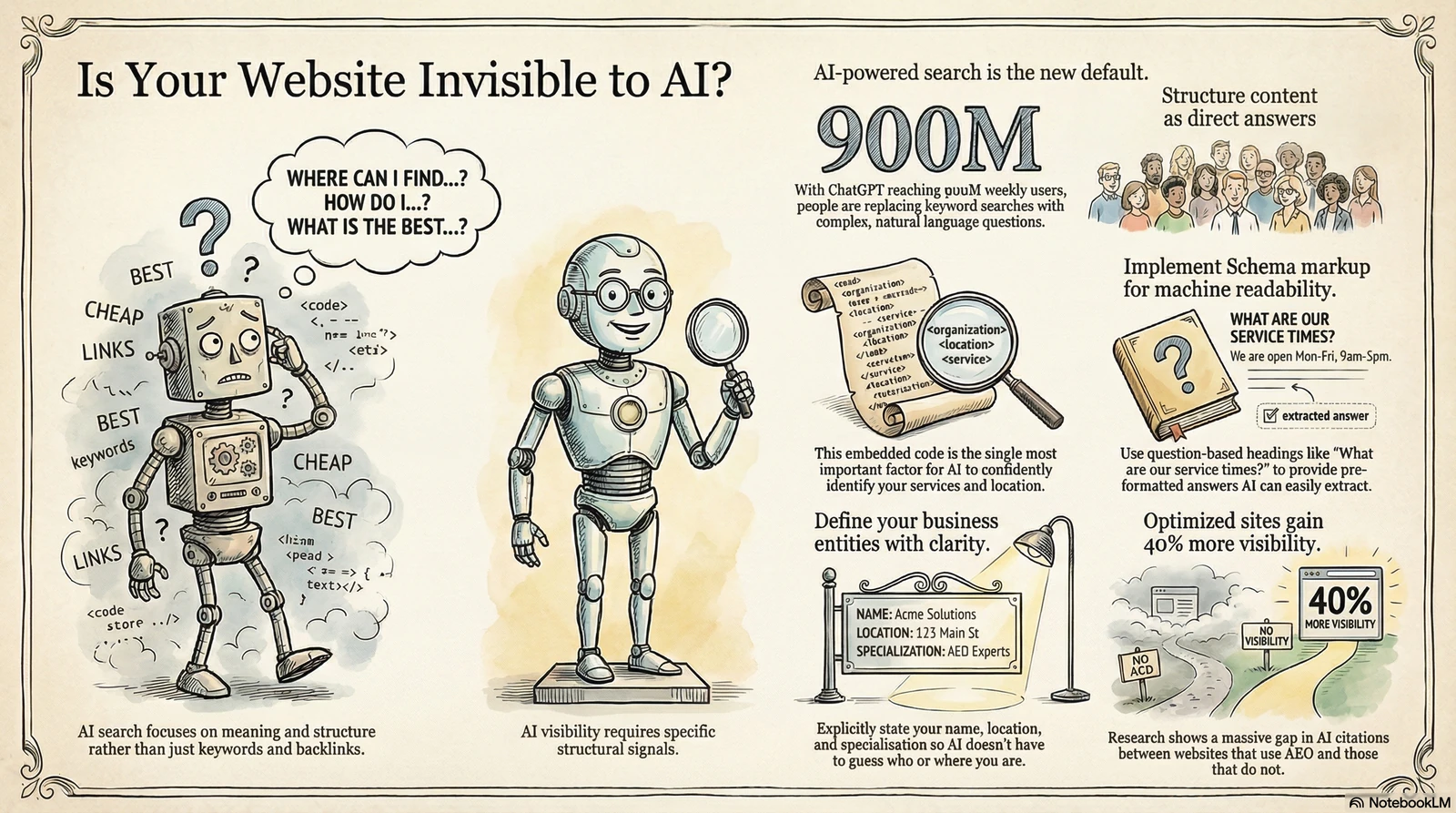
AI doesn't browse your site the way a person does. It doesn't admire your hero image or read your About page top to bottom. It scans for specific structural signals that help it understand what your business is, what you offer, and whether you're a trustworthy source. Here's what matters most:
Structured data (schema markup). This is code embedded in your website that can describe your business name, location, services, hours, reviews, and more. It can help systems interpret public information, but it does not guarantee citation or recommendation. Schema is one useful signal among many.
Question-based headings. When your pages use headings that match the questions people ask AI — "What are your service times?" or "Do you accept new patients?" — you're giving AI pre-formatted answers it can extract and cite directly. FAQ sections structured with proper headings are especially powerful.
Entity clarity. AI needs to know immediately and unambiguously: What is this business? Who runs it? Where is it located? What does it specialize in? If that information is scattered across pages, buried in paragraphs, or missing entirely, AI can't build a clear picture of who you are.
Content freshness. AI systems prefer recently updated content with clear date metadata. A website that hasn't been touched since 2021 signals to AI that the information may be outdated and unreliable. Regular updates, blog posts, and visible dates all help.
Authoritative signals. Reviews, testimonials, professional credentials, and affiliations can provide useful public context about a business. They do not guarantee that an AI system will cite or recommend it.
AI doesn't browse your site like a person. It scans for structured signals — schema, questions, entities, dates. If those signals aren't there, you don't exist to AI.
Why Traditional SEO Isn't Enough
If you've already invested in SEO, that's a solid foundation. But SEO and AI visibility are not the same thing. SEO gets you into Google's index — it helps you rank in the traditional list of blue links. AI visibility — sometimes called AEO, or Answer Engine Optimization — gets you into AI-generated answers. They're complementary, not interchangeable.
A page can rank on the first page of Google and still be completely invisible to ChatGPT. How? Because traditional SEO focuses on keywords, backlinks, and page authority. AI systems focus on meaning and structure. They need to understand your content at an entity level — not just match keywords. If your site is missing the technical SEO basics, start there. But don't stop there.
In practice, sites that structure content specifically for AI answer engines — clear entity signals, direct answers, well-formed schema — show up in AI responses far more often than sites that only optimize for traditional search. That gap is the whole reason AEO is worth doing on its own, not as an afterthought to SEO.
What Is AEO?
AEO stands for Answer Engine Optimization. The goal is straightforward: when an AI system is asked a question that your business could answer, your website is the source it pulls from and cites.
This isn't about gaming an algorithm. It's about making your content clear, structured, and authoritative enough that AI systems trust it. You're not tricking AI into recommending you — you're giving it the information it needs to recommend you confidently.
You may hear about an llms.txt file — a plain-text summary placed at your site root for AI crawlers. The evidence so far says it doesn't do that job, and Google says you don't need new AI text files to appear in its AI features. The full explanation is in SEO Advice That Stopped Working. Correction, September 2026: this paragraph originally presented llms.txt as a promising direction.
The core principle is simple. If you want AI to recommend you, make it easy for AI to understand you.
What You Can Do Today
You don't need to become a developer or learn to code. These are practical steps that any web professional can implement for you — and that you can verify yourself.
1. Add accurate structured data. Organization or LocalBusiness schema and Service schema are good basics, as long as they match what's visible on the page. Schema describes your facts; it isn't an AI opt-in. Google says there's no special schema you need to add for its AI features. Correction, September 2026: this step used to list FAQ schema as a minimum and call schema the highest-impact change. Google's FAQ rich results stopped appearing in May 2026, and clear visible answers matter more than any markup.
2. Structure content as questions and answers. Use headings that match how real people ask AI for help. "What services do you offer?" is better than "Our Services" because it mirrors natural language queries. Add a genuine FAQ section to your most important pages.
3. Make your entities crystal clear. Your business name, location, services, specializations, and credentials should be explicit and prominent — not buried in a footer or hidden on an About page nobody visits. If a church website doesn't mention its denomination, location, and service times within the first scroll, AI won't know those details. If a healthcare practice doesn't list its specialties and providers clearly, AI can't recommend it.
4. Keep your content fresh. Add dates to pages and posts. Update service information regularly. Publish new content — even a monthly blog post signals to AI that your site is active and current.
5. Run a visibility scan. The Artifex Visibility Report is a free automated on-page website diagnostic. It checks selected public-page signals across technical health, on-page search signals, structured information, and content clarity. It does not test what ChatGPT or Google AI sees, or predict citations. About 30 seconds.
You don't need to understand AI to be found by it. You need a website that's structured clearly enough for AI to read. That's what AEO does.
Want to know where you stand without doing the audit yourself? That is the heart of our Google + AI search optimization service — and the free scan shows you your score first.