
Listen instead
Your website looks great. Your designer did a nice job. The colors match your brand, the images are sharp, and the contact form works. You launched it, shared it on social media, and waited for the phone to ring.
But it didn't. Or at least, not the way you expected.
Here's the thing most business owners don't realize: a beautiful website and a visible website are not the same thing. Design is what your visitors see. But several less-visible responsibilities also need an owner: the information search systems can read, the measurement that shows what is working, and the performance work that keeps the page usable. Here are five questions worth asking about your own site.
1. There's No Structured Data
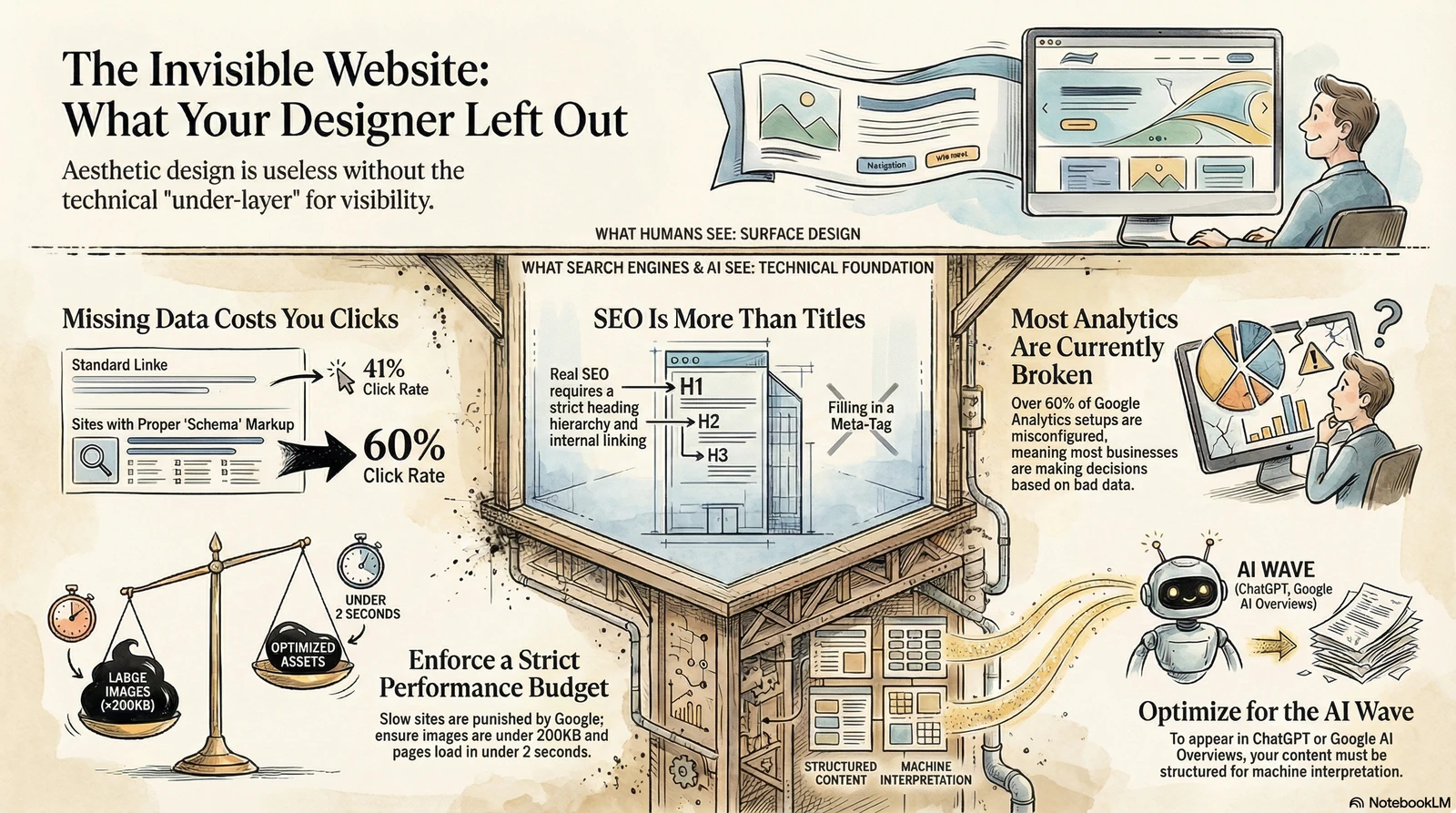
Structured data — also called schema markup — is a layer of code that can give search engines explicit information about who you are, what you do, where you're located, and what services you offer. It should match the visible content on the page.
Structured data can make a page eligible for the rich-result types Google supports when the content and implementation qualify. It does not guarantee a rich result, a ranking, or an appearance in an AI answer. The practical question is simpler: who is responsible for keeping your public business information accurate and machine-readable?
Not every page needs the same schema, and not every site needs a large schema implementation. A capable designer, developer, or SEO partner can handle it; the important thing is that the responsibility is explicit rather than assumed.
Schema markup is invisible to visitors, but it can help search systems interpret information already visible on the page. Ask who owns it and how it will be kept accurate.
2. SEO Stops at the Title Tag
When your designer said the site was "SEO-optimized," they probably meant they filled in a title tag and a meta description on each page. That's a start — but it's not a strategy.
Real SEO means building a logical heading hierarchy on every page (H1, then H2, then H3 — not random). It means internal linking between related pages so Google can understand how your content connects. It means writing descriptive alt text for every image, structuring clean URLs, and mapping keywords across the entire site so each page targets something specific.
A title tag without the rest is like putting a sign on a building with no doors. Google can see the sign, but it can't get inside. If your designer handed off a site with title tags and nothing else, you're running on a fraction of your SEO potential.
3. Nobody Set Up Analytics
You can't improve what you don't measure. Google Analytics (GA4) and Google Search Console should be configured and collecting data before your site goes live. GA4 tells you who's visiting, where they come from, and what they do on your site. Search Console tells you what people are searching for when they find you — and when they don't.
Some websites launch with no analytics at all, or with analytics installed but never properly configured — missing conversion tracking, broken event setup, or incomplete data streams. In either case, the owner is making decisions with incomplete evidence.
If your designer didn't set up GA4 and Search Console — or didn't walk you through what the data means — you've been making decisions without evidence. Every month that goes by without proper tracking is a month of lost insight you can never get back.
4. The Site Has No Performance Budget
Beautiful sites can also be painfully slow. Performance affects how people experience a page, and it is one of many signals Google considers.
Google's Core Web Vitals measure loading, responsiveness, and visual stability. They are useful field signals to review, but no single experience score guarantees — or prevents — a ranking. Check real-user data alongside the rest of the site's technical and content foundation.
The most common culprit is images. A designer uploads a full-resolution photo straight from a camera or stock library — 2 to 3 megabytes for a single image. Multiply that across five or six pages, and your visitors are downloading 15MB of images before they see anything useful. Add render-blocking CSS, unoptimized web fonts, and no lazy loading, and you have a site that looks gorgeous on the designer's fast office connection but crawls on a phone.
A performance budget means agreeing on sensible limits before launch, then testing the actual pages. The targets should fit the site, its audience, and its media — not a one-size-fits-all checklist.
5. Public Content Is Unclear
This is a newer area of website strategy, and it is easy to overstate.
People now encounter information through traditional search results, Google AI features, and independent AI tools. Those systems do not work identically, and their outputs can change from query to query.
AI systems use public content in different ways. Clear headings, direct answers, and accurate schema can make that content easier to find and understand. Citation is not guaranteed, and no single formatting choice controls it.
AEO (Answer Engine Optimization) and GEO (Generative Engine Optimization) are useful labels for studying those changes, not a promise of a new technical switch. Clear public information, direct answers, and accurate markup are a sensible foundation; they do not guarantee visibility or citation. We break the distinction down further in AEO Explained.
Make your public information clear for people first. That also gives search and AI systems better material to interpret, without promising a specific outcome.
What Should You Expect?
These responsibilities are not mysterious add-ons. Their depth depends on the site's scope, but each needs an explicit owner if the website is meant to support real business goals.
A thorough web build defines the appropriate structured data, search foundations, analytics setup, and performance checks before launch. It also keeps public content clear and accurate. Those choices help the right people and systems understand the site; they do not ensure rankings, citations, or leads.
That's the Artifex standard. Not because it's trendy, but because a website that can't be found isn't doing its job. Take a look at real examples of what this looks like in practice, or learn more about our approach.
One more useful question: SEO should not be an upsell mystery. Here is exactly what our SEO service includes, with real prices printed.